


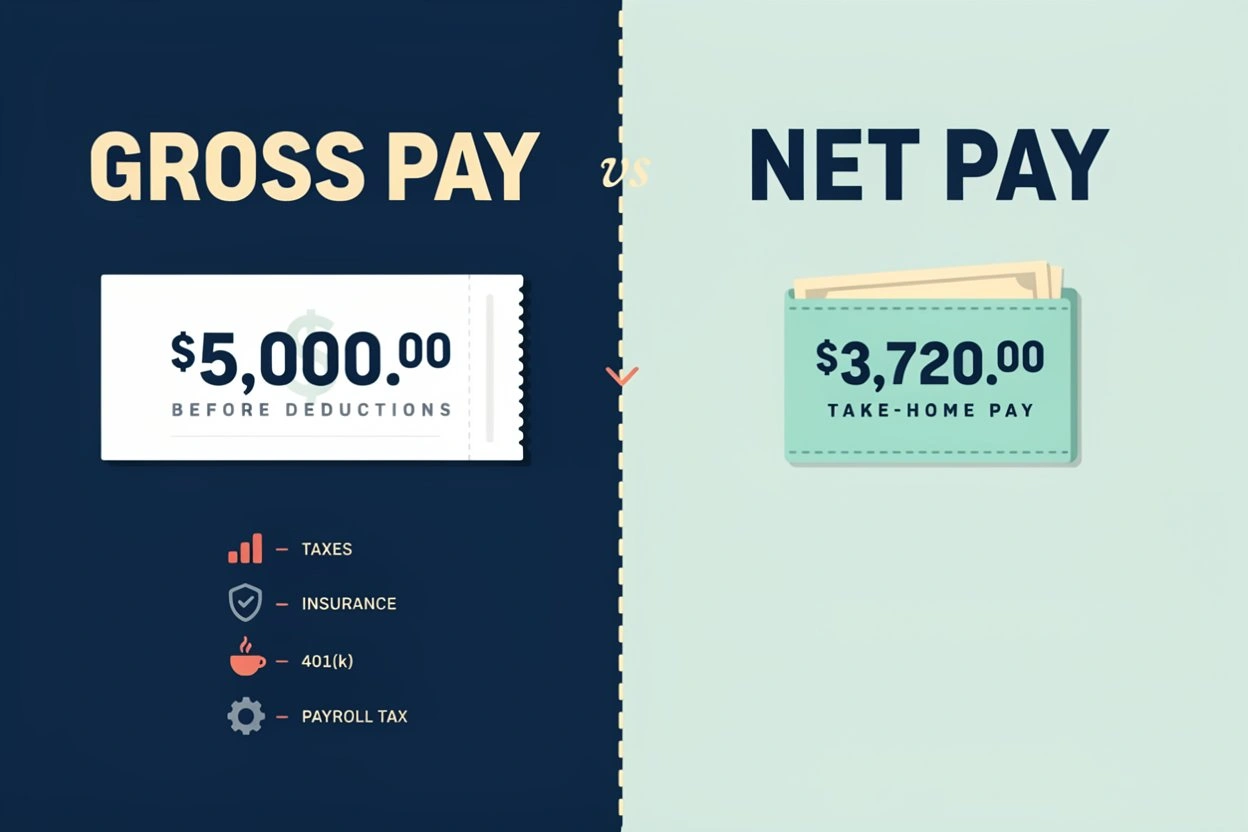
Gross pay vs net pay refers to the difference between total earnings before deductions and the amount you actually receive after taxes, insurance premiums, retirement contributions, and other payroll deductions. Understanding these figures helps you read your paycheck correctly, compare job offers with greater accuracy, create realistic monthly budgets, and make informed financial decisions. Whether you are a salaried employee, hourly worker, freelancer, or employer, knowing how gross pay and net pay are calculated can reduce payroll confusion, improve financial planning, and help you identify errors on your pay stub while giving you a clearer picture of your actual take-home income.
What Is Gross Pay?
Gross pay is the total amount of money an employee earns before any deductions are applied. It reflects the full compensation agreed upon between an employer and an employee. Gross pay is the starting point for payroll calculations and forms the basis for determining taxes, retirement contributions, and many employee benefits.
For salaried employees, gross pay usually remains consistent during each pay period unless additional earnings such as bonuses or commissions are included. Employees paid by the hour may see their gross pay change regularly because it depends on the number of hours worked during each pay cycle.
Gross pay may include regular wages along with overtime earnings, holiday pay, shift differentials, bonuses, commissions, performance incentives, and other forms of compensation. Because no deductions have yet been made, gross pay is always higher than the amount an employee ultimately receives.
Employers use gross pay when preparing payroll records, calculating tax withholdings, reporting employee earnings, and determining eligibility for certain workplace benefits. Financial institutions also commonly review gross income when evaluating mortgage applications, personal loans, or credit approvals.
What Is Net Pay?
Net pay is the amount of money an employee receives after all required and voluntary deductions have been subtracted from gross pay. This figure is commonly known as take-home pay because it reflects the actual income available for spending, saving, and paying monthly expenses.
Unlike gross pay, net pay considers taxes and payroll deductions that reduce an employee’s earnings before payment is issued. The final amount deposited into a bank account or printed on a paycheck is the employee’s net pay.
Several deductions may reduce gross pay before it becomes net pay. Income taxes, retirement plan contributions, health insurance premiums, dental coverage, vision insurance, life insurance, wage garnishments, and other authorized deductions all affect the final payment received by the employee.
Because every employee’s deductions are different, two individuals earning the same gross salary may receive different net pay amounts. Personal tax situations, benefit selections, retirement contributions, and local tax regulations all influence the final figure.
Gross Pay vs Net Pay: Understanding the Difference
The simplest way to understand gross pay vs net pay is to view payroll as a two-step process. Employers first calculate an employee’s total earnings for the pay period. This amount becomes the employee’s gross pay. Payroll deductions are then applied according to tax regulations and employee benefit selections. The remaining balance becomes net pay.
For example, an employee may earn a gross monthly salary of $5,000. During payroll processing, deductions for income tax, retirement contributions, health insurance, and other payroll obligations are subtracted. After these deductions are removed, the employee may receive a net payment of approximately $3,900. While the employee earned $5,000, only $3,900 is available for personal use.
This distinction is important because many financial decisions should be based on net income rather than gross income. Household budgets, savings goals, loan repayments, and monthly expenses depend on the money that actually reaches an employee’s account.
Why Understanding Gross Pay vs Net Pay Is Important
Understanding gross pay vs net pay benefits both employees and employers. Employees who understand payroll calculations are better prepared to evaluate job offers, estimate monthly income, identify payroll errors, and create realistic budgets.
Many people focus only on advertised salaries without considering payroll deductions. A job offering a higher gross salary may not always result in substantially higher take-home pay if deductions increase significantly. Comparing estimated net pay provides a more accurate picture of actual earnings.
Employers also benefit from educating workers about payroll terminology. Transparent payroll practices reduce confusion, improve trust, and minimize disputes regarding paycheck amounts. Employees who understand how deductions work are less likely to question legitimate payroll adjustments.
Financial planning also becomes easier when individuals understand the relationship between gross and net income. Saving for retirement, planning investments, and managing household expenses all require accurate knowledge of take-home earnings.
Components That Make Up Gross Pay
Gross pay consists of more than regular wages. Many employers include several forms of compensation that increase total earnings during a pay period.
Regular salary or hourly wages form the foundation of gross pay. Overtime compensation rewards employees for working beyond standard hours. Bonuses recognize exceptional performance or company achievements, while commissions reward sales employees based on revenue generated.
Some employers also include shift differentials for evening or overnight work, holiday pay for working during public holidays, attendance incentives, productivity bonuses, and paid leave compensation. All these earnings contribute to gross pay before deductions are calculated.
Because gross pay includes every eligible form of compensation, employees should review their pay stubs carefully to confirm that all earnings have been recorded accurately.
Factors That Influence Net Pay
While gross pay reflects total earnings, net pay depends largely on payroll deductions. Several factors determine how much money an employee ultimately receives.
Income tax is often the largest deduction from gross earnings. The amount withheld depends on tax laws, income level, filing status, and applicable tax brackets.
Retirement savings plans also reduce take-home pay because employees contribute a portion of their earnings toward future retirement benefits. Although these contributions reduce current net income, they provide long-term financial security.
Health insurance premiums, dental insurance, vision coverage, and life insurance further reduce take-home earnings. Employees selecting comprehensive benefit packages typically receive lower net pay than employees with fewer payroll deductions.
Voluntary deductions such as charitable donations, employee stock purchase plans, or flexible spending accounts may also affect net income. Each payroll deduction decreases the amount employees receive while often providing valuable financial or health benefits.
Employers calculate these deductions according to payroll regulations before issuing employee payments, making accurate payroll systems essential for both legal compliance and employee satisfaction.
Common Payroll Deductions That Reduce Net Pay
One of the biggest reasons employees notice a difference between gross pay and net pay is payroll deductions. These deductions are amounts withheld from an employee’s gross earnings before the final paycheck is issued. Some deductions are required by law, while others are chosen voluntarily by the employee.
Income tax is usually the largest deduction on a paycheck. Employers calculate tax withholding based on the employee’s earnings, tax status, and the tax regulations in the country or state where they work. Since tax rates vary according to income, employees earning higher salaries often have larger tax deductions.
Retirement contributions are another common deduction. Many employers offer retirement savings plans that allow employees to contribute a percentage of their earnings. Although these contributions reduce take-home pay today, they help employees build long-term financial security.
Health insurance premiums also reduce net pay. Employees who participate in employer-sponsored medical plans generally have a portion of the premium deducted from each paycheck. Some employers also offer dental, vision, disability, and life insurance plans that require additional payroll deductions.
Certain employees may also have deductions for union membership fees, wage garnishments, charitable contributions, or employee benefit programs. Since every employee’s payroll profile is unique, the final net pay amount can differ even when two employees have identical gross salaries.
Gross Pay vs Net Pay for Salaried Employees
For salaried employees, gross pay usually remains consistent throughout the year because annual compensation is divided equally across each pay period. If an employee earns an annual salary of $84,000 and receives monthly payments, the monthly gross pay equals $7,000 before deductions.
After payroll processing begins, deductions for taxes, retirement savings, insurance premiums, and other authorized items are subtracted. The remaining balance becomes the employee’s net pay.
Although gross salary generally stays the same, net pay may change occasionally. Employees who modify their retirement contribution percentage, enroll in a different insurance plan, receive a performance bonus, or experience tax withholding adjustments may notice changes in their take-home income.
Understanding these changes helps salaried employees avoid confusion when paycheck amounts differ slightly from previous pay periods.
Gross Pay vs Net Pay for Hourly Employees
Hourly employees often experience greater variation in both gross pay and net pay because their earnings depend on the number of hours worked during each pay period.
For example, an employee working forty hours one week and forty-eight hours the following week will receive different gross earnings. Additional overtime hours increase total compensation before deductions, resulting in higher gross pay.
Since payroll taxes and certain deductions are calculated as a percentage of earnings, larger gross pay generally leads to higher deductions. Even though net pay increases with overtime, the increase is not always equal to the total additional earnings because payroll deductions also increase.
Seasonal workers, temporary employees, and part-time staff frequently notice changing paycheck amounts because their work schedules vary throughout the year.
Gross Pay vs Net Pay for Freelancers and Independent Contractors
Freelancers and independent contractors operate differently from traditional employees because they usually receive payments without payroll deductions.
When a client pays a freelancer, the payment typically represents the full agreed-upon amount for the completed work. Unlike employees, freelancers are responsible for managing their own taxes, insurance, retirement savings, and business expenses.
For example, a freelance graphic designer who invoices a client for $3,000 usually receives the entire payment. However, that amount is not the true take-home income because taxes and business expenses still need to be paid later.
Many freelancers set aside a portion of each payment specifically for taxes to avoid financial difficulties during tax season. Although they initially receive what appears to be gross income, their actual net earnings become lower after accounting for taxes and operating costs.
Gross Pay vs Net Pay When Bonuses Are Paid
Bonuses are an important part of employee compensation and directly affect gross earnings. Companies may offer annual bonuses, holiday bonuses, signing bonuses, retention bonuses, or performance incentives based on individual or company performance.
When a bonus is added to a paycheck, it increases gross pay immediately. However, because bonuses are generally subject to payroll taxes and other deductions, employees should not expect to receive the entire bonus amount as additional take-home pay.
For example, an employee receiving a $2,000 bonus will see gross pay increase by that amount. After payroll deductions are applied, the actual increase in net pay will usually be less than $2,000.
Understanding this process helps employees avoid disappointment when reviewing bonus payments.
Gross Pay vs Net Pay and Overtime Earnings
Overtime is another factor that influences both gross and net income. Many employment laws require overtime to be paid at a higher hourly rate once employees exceed standard working hours.
Suppose an employee earns $22 per hour and works several overtime shifts during a pay period. The overtime premium increases gross earnings substantially. However, because taxes and payroll deductions also increase, the final net pay will not rise by the exact overtime amount earned.
Employees often misunderstand this relationship and assume they have “lost” money due to taxes. In reality, overtime still increases take-home income, although deductions naturally become larger because total earnings have increased.
Why Gross Pay Is Used During Salary Negotiations
Employers almost always discuss compensation using gross annual salary rather than net pay. Gross salary provides a standardized figure that remains consistent regardless of each employee’s personal tax situation.
For example, two candidates accepting identical positions may have different family situations, retirement contributions, or insurance selections. These differences affect net pay but not gross salary.
Using gross income allows employers to present equal compensation packages without considering individual financial circumstances.
Job seekers should remember that advertised salaries represent gross earnings rather than expected monthly deposits. Estimating net pay before accepting an offer provides a more accurate understanding of actual income.
Gross Pay vs Net Pay in Loan Applications
Financial institutions often review gross income when assessing loan eligibility because it reflects an applicant’s total earning capacity before deductions.
Mortgage lenders, banks, and other financial organizations frequently calculate debt-to-income ratios using gross monthly income. This helps them evaluate whether borrowers can reasonably afford additional debt.
Although gross pay plays an important role during loan approval, borrowers should personally evaluate loan affordability using net pay. Monthly repayments come from take-home income rather than total earnings.
Balancing both figures allows borrowers to avoid taking on financial commitments that exceed their actual spending capacity.
Common Payroll Mistakes Employees Should Watch For
Payroll systems are highly accurate in most organizations, but mistakes can still occur. Employees should review every paycheck carefully to confirm that all earnings and deductions are correct.
Errors sometimes occur when overtime hours are omitted, bonuses are recorded incorrectly, tax withholding information is outdated, or benefit deductions continue after an employee changes insurance plans.
Incorrect vacation pay, duplicate deductions, or missing commission payments can also affect both gross and net earnings.
Regularly reviewing pay stubs allows employees to identify discrepancies early and request corrections before small errors become larger financial problems.
Understanding Your Pay Stub
Every employee should know how to read a pay stub because it provides a detailed breakdown of payroll calculations.
A typical pay stub begins with employee information, employer details, and the pay period. It then displays gross earnings, showing regular wages along with overtime, bonuses, commissions, or other forms of compensation earned during that period.
Below the gross earnings section are payroll deductions. These deductions may include taxes, retirement contributions, insurance premiums, and other authorized withholdings.
The final section displays net pay, which represents the amount the employee actually receives. Most pay stubs also include year-to-date totals that summarize cumulative earnings and deductions for the current tax year.
Carefully reviewing each section helps employees better understand how their paycheck is calculated and provides valuable records for tax filing and financial planning.
Common Misconceptions About Gross Pay vs Net Pay
Many employees misunderstand how payroll works, leading to confusion when they receive their first paycheck or compare job offers. One of the most common misconceptions is that the salary mentioned in an employment offer is the amount that will be deposited into a bank account. In reality, employers almost always quote gross salary because net pay depends on an individual’s taxes, benefit selections, and other deductions.
Another misconception is that earning more automatically means keeping all of the additional income. While a salary increase, bonus, or overtime payment raises gross pay, payroll deductions generally increase as well. Employees still receive more take-home pay, but the increase is usually smaller than the total amount added to gross earnings.
Some people also believe payroll deductions are errors because their paycheck is lower than expected. In most cases, deductions are legitimate and include mandatory tax withholdings along with any voluntary benefits the employee has selected. Reviewing a pay stub carefully helps explain why net pay differs from gross pay.
It is also common to assume that employees with identical salaries receive identical paychecks. Since tax status, retirement contributions, insurance plans, and other deductions vary from person to person, two employees with the same gross salary can receive noticeably different net pay.
How Employers Calculate Gross Pay vs Net Pay
Payroll processing follows a structured sequence to ensure employees are paid accurately and legal obligations are met.
The process begins by calculating gross pay. For salaried employees, this usually involves dividing the annual salary by the number of pay periods. For hourly employees, gross pay depends on hours worked, overtime, commissions, bonuses, and any additional compensation earned during the payroll period.
Once gross earnings have been determined, payroll software applies the required deductions. Mandatory deductions such as income tax and other statutory contributions are calculated according to current tax regulations. Voluntary deductions, including retirement contributions and insurance premiums, are then applied based on the employee’s benefit elections.
After every deduction has been processed, the remaining amount becomes the employee’s net pay. Employers then issue payment through direct deposit, paper checks, or other approved payment methods while generating a detailed pay stub for the employee’s records.
Modern payroll software automates much of this process, reducing calculation errors and helping employers comply with tax reporting requirements.
Gross Pay vs Net Pay Example
A practical example makes the difference between gross pay and net pay much easier to understand.
Imagine an employee earns a monthly gross salary of $6,500. During payroll processing, income tax, retirement contributions, health insurance premiums, and other payroll deductions total $1,450.
The payroll calculation would appear as follows:
Gross Monthly Pay: $6,500
Total Payroll Deductions: $1,450
Net Monthly Pay: $5,050
Although the employee earned $6,500 during the month, only $5,050 becomes available for spending after deductions had been applied.
Now consider another employee earning the same gross salary but choosing a higher retirement contribution and more comprehensive health insurance coverage. Their total deductions may reach $1,700, resulting in lower net pay despite identical gross earnings.
This example demonstrates why comparing only gross salaries does not always provide an accurate picture of actual income.
Gross Pay vs Net Pay and Financial Planning
Understanding gross pay vs net pay plays a major role in effective financial planning. Gross income is useful when applying for mortgages, negotiating salaries, or completing tax-related documentation. However, day-to-day financial decisions should always be based on net income.
Monthly expenses such as rent, mortgage payments, groceries, transportation, utility bills, loan repayments, and savings contributions all come from take-home pay. Using gross salary as the basis for budgeting can create unrealistic expectations and increase the risk of overspending.
Individuals who consistently plan their finances around net pay are generally better prepared to manage emergencies, save for future goals, and avoid unnecessary debt. Tracking take-home income also makes it easier to identify opportunities for increasing savings or reducing unnecessary expenses.
Tips for Managing Your Income Effectively
Understanding the relationship between gross pay and net pay allows individuals to make smarter financial decisions throughout their careers. Employees should always estimate their expected take-home income before accepting a new job rather than focusing only on the advertised annual salary.
Budgeting should be based on net income because it represents the actual money available after payroll deductions. This approach creates more realistic spending plans and reduces financial stress.
Employees should also review their retirement contributions periodically. Increasing retirement savings may reduce current take-home pay, but it can significantly strengthen long-term financial security. Likewise, reviewing insurance options during benefit enrollment periods helps employees balance monthly deductions with the coverage they need.
Whenever overtime, bonuses, or commissions are earned, employees should remember that additional deductions may apply. Understanding this relationship prevents unrealistic expectations when the paycheck arrives.
Finally, regularly reviewing payroll records helps identify calculation errors quickly and provides accurate documentation for tax reporting and future financial planning.
Which Is More Important: Gross Pay or Net Pay?
The answer depends on the purpose.
Gross pay is important because it represents total compensation before deductions. Employers use gross pay when advertising salaries, preparing payroll records, calculating taxes, and reporting employee earnings. Financial institutions often rely on gross income when evaluating mortgage applications and personal loans.
Net pay is more important for everyday life because it reflects the amount employees actually receive. Household budgets, monthly bills, emergency savings, investments, and daily spending all depend on take-home income rather than total earnings.
Instead of viewing one figure as more important than the other, employees should understand how both figures work together. Gross pay provides a complete picture of earnings, while net pay shows the income available for real-world financial decisions.
Conclusion
Understanding gross pay vs net pay is essential for making informed financial decisions throughout your career. Gross pay represents the total earnings before deductions, while net pay reflects the amount available after taxes, insurance premiums, retirement contributions, and other payroll deductions have been applied. Although both figures appear on every paycheck, they serve different purposes and should not be used interchangeably.
Gross pay is valuable for salary negotiations, employment contracts, tax reporting, and financial applications. Net pay, on the other hand, is the figure that determines how much money is actually available for everyday expenses, savings, investments, and long-term financial planning. Knowing how payroll deductions affect take-home income helps employees create realistic budgets, compare job offers accurately, and identify payroll errors when they occur.
By understanding how gross earnings are calculated, what deductions reduce take-home pay, and why both numbers matter, employees can gain greater confidence in managing their finances. Whether you are entering the workforce, changing careers, or reviewing your monthly paycheck, a clear understanding of gross pay vs net pay provides the knowledge needed to make smarter financial decisions.
FAQs
What is the difference between gross pay and net pay?
Gross pay vs net pay refers to the difference between your total earnings before deductions and the amount you actually receive after taxes, insurance premiums, retirement contributions, and other payroll deductions have been applied.
How is gross pay vs net pay calculated?
Gross pay vs net pay is calculated by starting with total earnings before deductions. After subtracting required taxes and any voluntary deductions such as health insurance or retirement contributions, the remaining amount becomes net pay.
Why is gross pay vs net pay important when accepting a job offer?
Understanding gross pay vs net pay helps you estimate your actual take-home income instead of relying only on the advertised salary. This makes it easier to compare job offers and plan your monthly budget accurately.
Can gross pay vs net pay change from one paycheck to another?
Yes. Gross pay vs net pay can change if you work overtime, receive bonuses or commissions, adjust retirement contributions, change insurance coverage, or if tax withholding amounts are updated.
Which is more useful for budgeting: gross pay vs net pay?
For personal budgeting, net pay is more useful because it represents the amount deposited into your account after deductions. Gross pay remains important for salary negotiations, tax reporting, and certain financial applications.
