


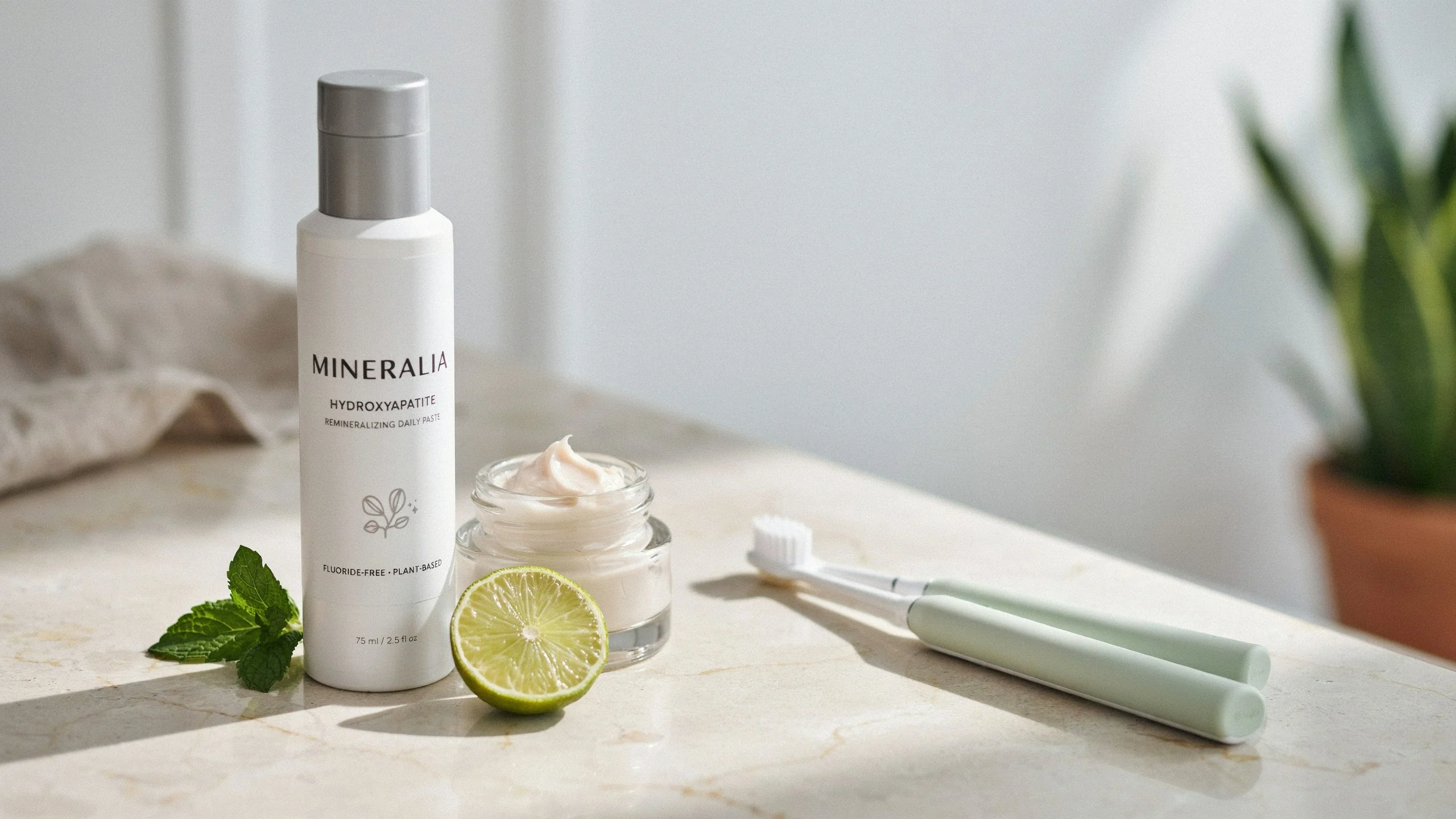
Hydroxyapatite toothpaste has become increasingly popular among people looking for an alternative to conventional fluoride toothpaste. Its main active ingredient, hydroxyapatite, is a mineral closely related to the natural mineral found in human teeth and bones. Because of this similarity, it has attracted attention for its potential role in supporting enamel, reducing tooth sensitivity, and maintaining everyday oral health.
While fluoride remains one of the most extensively studied ingredients for preventing dental cavities, hydroxyapatite offers a different approach. Rather than relying on fluoride to promote remineralization, hydroxyapatite toothpaste uses calcium-phosphate particles that can interact with the tooth surface.
What Is Hydroxyapatite Toothpaste?
Hydroxyapatite toothpaste is a toothpaste formulation that contains hydroxyapatite as an active or functional ingredient. Hydroxyapatite is a naturally occurring calcium-phosphate mineral represented chemically as calcium₁₀(PO₄)₆(OH)₂.
Human teeth contain a substantial amount of mineral material, with hydroxyapatite being a major component of tooth enamel and dentin. Enamel is the hard outer layer that protects the tooth, while dentin lies underneath and contributes to the tooth’s structure and sensitivity.
In toothpaste, hydroxyapatite is generally used in very small particles. Some products use conventional hydroxyapatite, while others use specially engineered particles known as nano-hydroxyapatite.
The basic idea is relatively straightforward: particles containing calcium and phosphate can come into contact with the tooth surface and potentially contribute minerals that support the enamel.
Hydroxyapatite toothpaste may also contain familiar toothpaste ingredients such as abrasives, humectants, flavoring agents, surfactants, and sweeteners. The exact formulation varies considerably between products.
How Does Hydroxyapatite Work?
Teeth are constantly exposed to processes that remove and restore minerals. This balance is known as demineralization and remineralization.
Acids produced by oral bacteria can lower the pH around teeth. Acidic foods and drinks can contribute to the same problem. When the environment becomes sufficiently acidic, minerals can be removed from enamel.
Saliva naturally helps counter this process by supplying minerals and buffering acids. Toothpaste can provide another source of active ingredients that interact with the tooth surface.
Hydroxyapatite toothpaste is designed to support this mineral-replenishment process. Hydroxyapatite particles can attach to enamel and may help fill microscopic surface irregularities. The calcium and phosphate components can contribute to mineral deposition under appropriate conditions.
This does not mean that toothpaste can rebuild a severely damaged or structurally destroyed tooth. Early enamel mineral loss is very different from a large cavity or a fractured tooth. Once significant tooth structure has been lost, professional dental treatment may be necessary.
Hydroxyapatite and Tooth Enamel
Tooth enamel is exceptionally hard, but it is not completely resistant to chemical damage. Repeated exposure to acids can gradually weaken its mineral structure.
Hydroxyapatite toothpaste is often marketed around the concept of enamel support because hydroxyapatite resembles the mineral naturally present in enamel.
The particles may adhere to the tooth surface and form a mineral-rich layer. This can potentially make the enamel surface less susceptible to certain forms of acid-related mineral loss.
The effectiveness depends on several factors, including particle characteristics, concentration, toothpaste formulation, brushing technique, frequency of use, and the individual’s oral environment.
For people concerned about enamel wear, toothpaste should be considered only one part of a broader approach. Acid exposure, aggressive brushing, frequent snacking, dry mouth, reflux, and other factors can contribute to enamel erosion.
Can Hydroxyapatite Toothpaste Help With Tooth Sensitivity?
Tooth sensitivity commonly occurs when dentin becomes exposed. Dentin contains microscopic channels that can transmit sensations toward the nerve inside the tooth.
Cold drinks, hot foods, sweet foods, or even air can sometimes trigger a short, sharp sensation when these areas are exposed.
Hydroxyapatite toothpaste may help sensitivity by depositing mineral material over exposed areas and potentially reducing access to the microscopic pathways in dentin.
Some studies have reported improvements in dentin hypersensitivity with hydroxyapatite-containing products. However, sensitivity has many possible causes, so toothpaste is not always the appropriate solution.
Persistent or worsening sensitivity can sometimes be associated with cavities, cracked teeth, gum recession, worn fillings, enamel erosion, or other dental problems.
If sensitivity continues despite consistent oral care, a dental examination is more appropriate than simply switching between toothpaste products.
Hydroxyapatite Toothpaste for Cavities
Cavities develop when bacteria, dietary sugars, and acids contribute to prolonged mineral loss from teeth. Preventing cavities therefore involves more than selecting a toothpaste.
Hydroxyapatite toothpaste may support enamel remineralization and help maintain the mineral content of teeth. Research has investigated hydroxyapatite as a cavity-prevention ingredient, including comparisons with fluoride-based products.
However, fluoride has a much larger evidence base and remains a standard ingredient in many cavity-prevention recommendations.
People at elevated risk of dental caries should therefore be cautious about assuming that every hydroxyapatite toothpaste provides the same level of cavity protection as a fluoride toothpaste. The formulation, concentration, and individual’s risk profile matter.
Anyone with frequent cavities, extensive dental restorations, orthodontic appliances, reduced saliva, or other risk factors should discuss toothpaste selection with a dentist.
Hydroxyapatite Toothpaste vs. Fluoride Toothpaste
The biggest question for many consumers is how hydroxyapatite compares with fluoride.
Fluoride works through several mechanisms that help teeth resist acid attacks and support remineralization. Its effectiveness in reducing dental caries has been demonstrated across decades of research.
Hydroxyapatite takes a mineral-based approach by supplying calcium-phosphate material that can interact directly with tooth surfaces.
Neither ingredient should be treated as a magic solution. Toothpaste works alongside brushing, saliva, diet, interdental cleaning, and professional dental care.
For someone with a low risk of cavities, hydroxyapatite toothpaste may be an appealing option. For someone with substantial caries risk, replacing fluoride without discussing the decision with a dental professional may not be advisable.
The right choice depends on the person’s oral-health needs rather than marketing claims alone.
What Is Nano-Hydroxyapatite?
Nano-hydroxyapatite consists of extremely small hydroxyapatite particles. Their small size can provide a large surface area relative to their volume, which may affect how they interact with tooth surfaces.
Nano-hydroxyapatite has been investigated for applications involving enamel remineralization and dentin sensitivity.
Its presence in toothpaste does not automatically mean a product is superior to one containing conventional hydroxyapatite. Particle size, concentration, manufacturing quality, formulation, and supporting evidence all matter.
Consumers should also distinguish between laboratory findings and demonstrated real-world clinical outcomes. A promising mechanism does not necessarily guarantee that a particular toothpaste will produce a noticeable benefit for every person.
Potential Benefits of Hydroxyapatite Toothpaste
Hydroxyapatite toothpaste may offer several potential oral-care benefits.
One important benefit is enamel mineral support. Hydroxyapatite can interact with the mineral structure of teeth and may assist remineralization of early enamel changes.
Another potential benefit is sensitivity reduction. By depositing mineral material around exposed dentin, hydroxyapatite may help reduce the movement of fluids within dentinal tubules, which is one mechanism associated with sensitivity.
Hydroxyapatite may also provide a smooth mineral-rich surface after brushing. Some formulations are designed to support a clean feeling while contributing to enamel care.
Another attraction is that hydroxyapatite is chemically similar to a naturally occurring mineral in teeth and bones. This similarity has contributed to its popularity among people seeking mineral-based oral-care products.
Still, these potential benefits should not be interpreted as proof that every hydroxyapatite toothpaste will work equally well. Product formulation and individual oral conditions matter.
Does Hydroxyapatite Whiten Teeth?
Hydroxyapatite toothpaste is sometimes promoted as a whitening toothpaste, but it is important to understand what “whitening” means.
Some toothpaste products can remove surface stains caused by coffee, tea, tobacco, and certain foods. This is different from changing the natural internal color of a tooth.
Hydroxyapatite itself should not be viewed as a bleaching agent comparable to professional whitening treatments. A hydroxyapatite toothpaste may make teeth appear cleaner or brighter if it helps remove surface deposits, but that does not necessarily mean it chemically bleaches the tooth.
People seeking significant color changes should understand the difference between stain removal and true tooth bleaching.
How to Use Hydroxyapatite Toothpaste
Using hydroxyapatite toothpaste is generally similar to using other toothpastes.
Apply an appropriate amount to a soft-bristled toothbrush and brush gently for about two minutes. Cover the outer, inner, and chewing surfaces of the teeth.
Avoid applying excessive pressure. Brushing harder does not necessarily clean teeth better and may contribute to gum irritation or tooth wear.
Cleaning between teeth is also important because a toothbrush cannot effectively reach every interdental surface. Depending on individual needs, floss, interdental brushes, or other cleaning aids may be appropriate.
For maximum benefit, consistency matters more than aggressive brushing.
Choosing a Hydroxyapatite Toothpaste
Not all hydroxyapatite toothpastes are identical. When comparing products, pay attention to the active ingredient, concentration, particle type, and overall formulation.
Products that clearly disclose their active ingredients and concentrations can make comparisons easier.
It is also worth checking whether the toothpaste contains other ingredients relevant to your needs. Someone with sensitive teeth may prioritize a formulation designed specifically for sensitivity, while someone primarily concerned with cavities may need to consider fluoride recommendations.
Avoid assuming that an expensive toothpaste is automatically more effective. Price can reflect branding, packaging, flavoring, formulation, or other factors that do not necessarily translate into better dental outcomes.
Who Might Consider Hydroxyapatite Toothpaste?
Hydroxyapatite toothpaste may appeal to adults who want a fluoride-free oral-care option or who are particularly interested in mineral-based dental products.
It may also be considered by people looking for additional support for enamel care or tooth sensitivity.
However, individual circumstances matter. Someone who regularly develops cavities should not make a major change in preventive care based solely on advertising.
Children also require particular consideration because toothpaste recommendations depend on age, cavity risk, and local dental guidance. Parents should follow recommendations from a pediatric dentist or other qualified dental professional rather than assuming that an adult hydroxyapatite toothpaste is appropriate for a child.
Possible Limitations and Considerations
Hydroxyapatite toothpaste is not a replacement for professional dental care.
It cannot remove established tartar, repair a large cavity, treat an infected tooth, or replace a damaged filling. It also cannot correct significant gum disease on its own.
Another limitation is that research does not necessarily apply equally to every product on the market. A study performed with a particular hydroxyapatite concentration or formulation cannot automatically be used to make claims about every toothpaste containing the ingredient.
Marketing language can also make products sound more definitive than the evidence supports. Terms such as “rebuilds enamel” can be misleading if interpreted as meaning that severely damaged enamel can simply grow back.
A realistic expectation is that hydroxyapatite toothpaste may support the maintenance and remineralization of tooth surfaces under appropriate conditions. It is not a substitute for dental treatment.
Is Hydroxyapatite Toothpaste Safe?
Hydroxyapatite has been studied extensively for dental applications, including its use in toothpaste formulations.
Safety depends partly on the formulation, particle characteristics, concentration, and intended use. Consumers should choose products manufactured by reputable companies and follow the product’s directions.
People with known allergies or unusual oral reactions should stop using a product that irritates and seek professional advice if symptoms persist.
For children, pregnancy, specific dental conditions, or high cavity risk, individualized advice from a dentist can be more useful than general product claims.
The Importance of Overall Oral Hygiene
Even the most sophisticated toothpaste cannot compensate for poor oral hygiene.
Brushing twice daily with appropriate technique is important. Cleaning between teeth helps remove plaque from areas a toothbrush cannot adequately reach. Limiting frequent exposure to sugary foods and acidic drinks can also reduce factors associated with tooth decay and erosion.
Regular dental examinations allow problems to be identified before they become more complicated.
Hydroxyapatite toothpaste can therefore be viewed as one component of an oral-care routine rather than the entire routine.
Conclusion
Hydroxyapatite toothpaste offers an interesting mineral-based approach to everyday oral care. Because hydroxyapatite is closely related to the mineral structure of teeth, researchers have investigated its potential to support enamel remineralization, reduce sensitivity, and contribute to cavity prevention.
Its biggest advantage is also the reason for its popularity: it is designed to work with the mineral composition of teeth rather than relying on fluoride as its primary active ingredient.
That does not mean hydroxyapatite toothpaste is automatically better than fluoride toothpaste. Fluoride remains exceptionally well established for preventing dental caries, and people with high cavity risk should take that evidence seriously.
For people considering hydroxyapatite toothpaste, the sensible approach is to look beyond marketing claims, examine the actual formulation, and consider personal dental needs. Good brushing technique, cleaning between teeth, a balanced diet, and regular dental care remain essential regardless of which toothpaste is chosen.
Frequently Asked Questions
What does hydroxyapatite toothpaste do?
Hydroxyapatite toothpaste provides calcium-phosphate mineral material that can interact with tooth surfaces. It may support enamel remineralization and can potentially reduce dentin sensitivity.
Can hydroxyapatite toothpaste replace fluoride?
For some people, hydroxyapatite may be an alternative they prefer, but fluoride has a much larger body of evidence for cavity prevention. People at high risk of cavities should discuss fluoride-free toothpaste with a dentist before making the switch.
Can hydroxyapatite repair damaged enamel?
It may support remineralization of early mineral loss, but it cannot regenerate severely damaged or missing tooth structure. Cavities and significant structural damage require professional dental treatment.
Does hydroxyapatite toothpaste help sensitive teeth?
Research suggests that hydroxyapatite-containing toothpaste can help reduce dentin sensitivity in some circumstances. Persistent sensitivity should still be evaluated by a dentist because it can have several underlying causes.
How often should hydroxyapatite toothpaste be used?
It can generally be used as part of a regular brushing routine according to the manufacturer’s directions. Consistent, gentle brushing is more important than using excessive toothpaste or pressure.
